
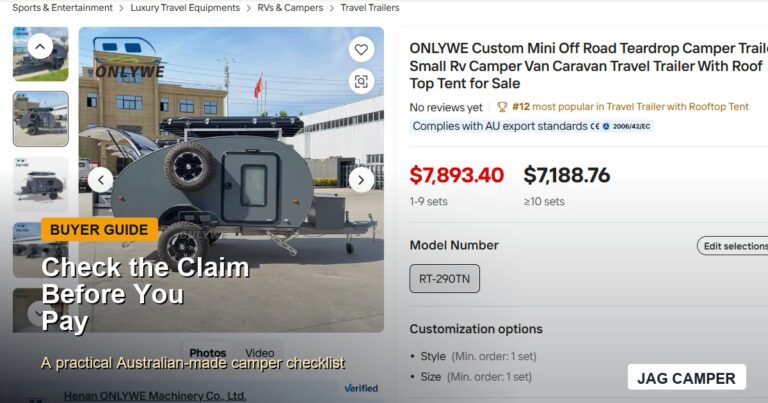
Learning how to check if a camper trailer is Australian made can protect you from vague marketing claims before you pay a deposit. For a buyer, country of origin affects trust, support, warranty, resale confidence and the questions worth asking before you commit.
The safest approach is not one magic question. It is a simple pattern of checks that makes unclear manufacturing claims harder to hide behind.
How to check if a camper trailer is Australian made: the short version
Start by asking where the body, chassis and fit-out are manufactured, then ask for evidence you can verify. A clear seller should be able to explain what is made locally, what is imported, and who handles warranty support in Australia.
Start with the exact wording
Read the wording carefully. “Australian made”, “Australian owned”, “Australian designed”, “Australian assembled” and “Australian supported” are not the same claim. A page can create a strong local impression without clearly saying where the camper body was manufactured.
Ask for the manufacturing breakdown
- Body or shell origin
- Chassis origin
- Cabinetry and fit-out origin
- Electrical and gas installation location
- Final inspection and handover location
- Warranty provider and repair location
Check public product similarities
If a camper looks very similar to overseas catalogue or marketplace listings, take a closer look. Similarity alone does not prove anything, but it is enough reason to ask better questions.
JAG’s related investigation, Chinese-Made Teardrop Campers Sold as Australian Made?, shows the kind of public comparison a buyer can do before committing.
Ask for proof you can verify
Useful proof is specific. Generic workshop photos, stock-style factory images or broad statements do not answer the real question. Ask for build photos of the actual model, workshop inspection options, supplier transparency and written confirmation of the origin claim.
Use official guidance as a baseline
The ACCC country-of-origin page explains how misleading origin claims can be reported. The Australian Made Campaign FAQ also explains how Australian Made rules connect to the Australian Consumer Law.
A quick buyer checklist
- Screenshot the claim before you enquire.
- Ask where the body, chassis and fit-out are made.
- Ask whether the camper is imported, assembled, modified or fully manufactured locally.
- Request build photos and compliance documents.
- Ask who does warranty work and where parts come from.
- Visit the workshop if the brand claims local manufacturing.
If you want to compare this with a locally built option, explore the JAG Teardrop Camper, the JAG Glider, or book a Brisbane factory visit to see how JAG builds and supports its campers.
FAQ
Can a camper use imported parts and still be Australian made?
Potentially, but the total claim needs to be accurate and not misleading.
Should I trust a logo or badge alone?
No. Treat badges as one signal, then check the manufacturing details behind the claim.
What if a seller avoids the question?
That is a warning sign. Clear manufacturers should be able to answer clearly.

