
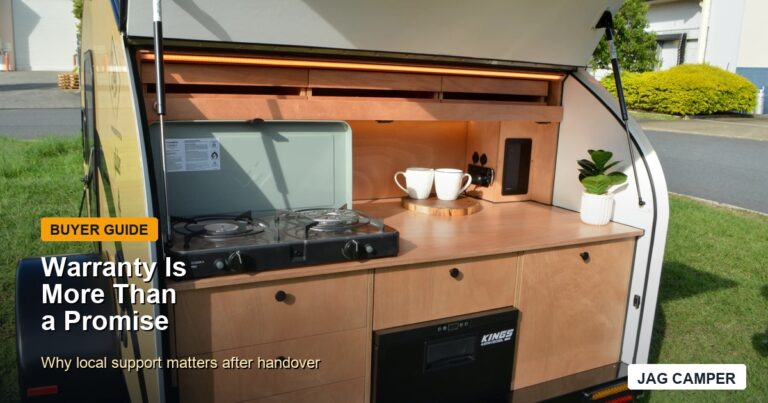
teardrop camper warranty Australia is not just a label on a website. For a buyer, it affects trust, support, warranty, resale confidence and the questions you should ask before paying a deposit. A warranty sounds simple until you need to use it. The important question is not just how long the warranty runs. It is who will actually help you.
What a useful warranty needs
- Clear written terms
- A real local contact
- Parts availability
- Repair capability
- Reasonable response times
- A seller who understands the product they sold
The risk with distant supply chains
Imported campers can be supported well, but only if the Australian seller has the parts, knowledge and process to back them up. If every major issue depends on an overseas supplier, small problems can become slow and frustrating.
Warranty questions to ask before buying
- Who performs warranty repairs?
- Where are common replacement parts stored?
- How long do parts usually take to arrive?
- What is excluded from the warranty?
- Is labour covered or only parts?
- What happens if the seller stops carrying the model?
Why local manufacturing can help
A local manufacturer is more likely to understand the build, have access to the right materials and make practical repairs or adjustments. That does not guarantee a perfect experience, but it gives the buyer a clearer path to support.
Connect warranty back to origin claims
If a brand leans heavily on Australian-made messaging, ask how that local claim connects to after-sales support. The JAG buyer guide on imported teardrop claims is a useful companion read.
If you want to compare this with a locally built option, explore the JAG Teardrop Camper, the JAG Glider, or book a Brisbane factory visit to see how JAG builds and supports its campers.
FAQ
Is a longer warranty always better?
No. A shorter warranty with strong local support can be more useful than a longer warranty that is hard to claim.
Should warranty answers be in writing?
Yes. Save written answers before paying a deposit.
Does local support matter for small campers?
Yes. Small campers still have doors, seals, wiring, cabinetry, hatches, suspension and parts that may need support over time.

