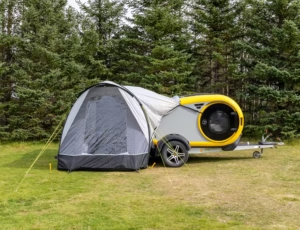
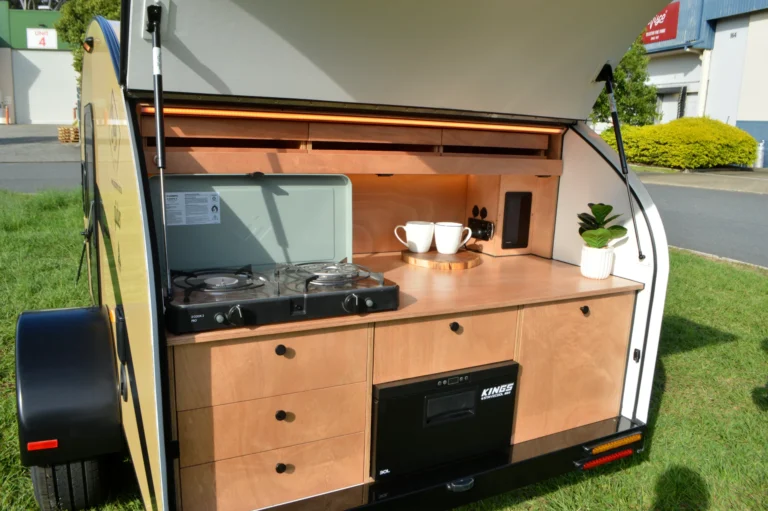
Caravan weights are one of the easiest parts of buying a camper to misunderstand. The numbers look simple on a brochure, but the real question is not just “what can my car tow?” It is whether the whole setup still works once you add water, food, passengers, tools, accessories, gas, bedding and the weight sitting on the tow ball.
After reading this guide, you should be able to read a compliance plate or spec sheet, understand the main weight terms, ask better questions before buying, and do a rough payload check before you commit to a caravan or camper trailer.
Quick answer: the numbers that matter most
If you only remember one thing, remember this: towing capacity is not the only limit. A legal and comfortable setup has to fit inside the trailer limits, vehicle limits, towbar limits, tow ball limit, payload, GVM and sometimes GCM at the same time.
| Term | Plain-English meaning | Why buyers care |
|---|---|---|
| Tare | The approximate empty weight of the caravan or camper. | This is your starting point before gear, water, food, gas and accessories. |
| ATM | Aggregate Trailer Mass: the maximum loaded trailer weight when it is not coupled to the car. | The loaded trailer must not exceed this number. |
| GTM | Gross Trailer Mass: the loaded weight on the trailer wheels when coupled to the tow vehicle. | This matters because some weight transfers onto the vehicle through the tow ball. |
| Tow ball weight | The vertical weight the trailer puts onto the towbar. | It counts against the tow vehicle and towbar limits, and can reduce vehicle payload. |
| Payload | How much you can add after tare. | Water, food, bedding, batteries, options and camping gear all use payload. |
| GVM | Gross Vehicle Mass: maximum loaded weight of the tow vehicle. | Passengers, luggage, accessories and tow ball weight can push the car over its limit. |
| GCM | Gross Combination Mass: maximum combined loaded weight of the vehicle and trailer. | Some vehicles cannot carry a full payload and tow their maximum braked limit at the same time. |
RACQ explains that ATM is the trailer and its full load when it is not coupled, while GTM is the loaded trailer weight imposed on the trailer axle when it is coupled. RACQ also notes that ball load is the actual weight imposed vertically on the rear of the tow vehicle, and it changes depending on how the trailer is loaded.
Worked example: how payload disappears on a real trip
Payload is usually the number people underestimate. It is simple maths, but the real-world loading adds up quickly.
Basic payload formula: ATM minus tare equals available trailer payload.
| Example camper | Example number |
|---|---|
| Tare | 850kg |
| ATM | 1500kg |
| Available payload | 650kg |
That looks comfortable at first. Now add a realistic touring load:
| Item added | Example weight | Remaining payload |
|---|---|---|
| Starting payload | – | 650kg |
| 70L water tank filled | About 70kg | 580kg |
| Gas bottle | About 9-18kg depending on bottle and fill | 562-571kg |
| Food, drinks and fridge contents | 30-60kg | 502-541kg |
| Bedding, clothes and camp chairs | 40-80kg | 422-501kg |
| Tools, hoses, leads and levelling gear | 25-60kg | 362-476kg |
| Recovery gear, extra battery, accessories or upgrades | Variable | Depends on fit-out |
This is why a camper with a good payload can still become overweight if it is loaded carelessly, and why a camper with a small payload can become limiting very quickly. Water is a good example because 1 litre is roughly 1kg. Fill two large tanks, add food and recovery gear, and the numbers are no longer theoretical.
ATM vs towing capacity: they are related, but not the same thing
A vehicle’s braked towing capacity tells you the maximum loaded trailer weight the vehicle is rated to tow, subject to the vehicle handbook, towbar rating and other limits. The trailer’s ATM tells you the maximum legal loaded mass of the trailer itself.
Queensland Government guidance says that if you are unsure about the combined mass of the trailer and load, have it weighed at a public weighbridge. RACQ also notes that, for vehicles under 4.5 tonnes GVM, the allowed trailer ATM is up to the lesser of the vehicle manufacturer’s recommended maximum towing mass or the towbar rating.
That means you should check all of these, not just the biggest number in the brochure:
- Vehicle braked towing capacity.
- Vehicle maximum tow ball download.
- Towbar maximum towing and ball load rating.
- Vehicle GVM and payload.
- Vehicle GCM, if listed.
- Trailer tare, ATM and GTM.
- Actual loaded weight once packed for a trip.
Tow ball weight can reduce your car’s usable payload
Tow ball weight is where many buyers get caught. The tow ball load is carried by the vehicle, not magically ignored because it came from the trailer. RAC notes that the vehicle’s load capacity includes passengers, luggage, accessories and any weight on the tow ball.
Here is a simple example:
| Vehicle payload example | Weight |
|---|---|
| Vehicle available payload | 500kg |
| Tow ball weight from camper | 120kg |
| Driver and passenger | 160kg |
| Kids, dog, fridge, tools or luggage in car | 120kg |
| Payload remaining | 100kg |
In that example, the car may still be under its braked towing capacity, but the vehicle payload is already getting tight. Add a bull bar, roof rack, drawer system, long-range tank or second battery and the margin can disappear.
What to ask the seller before buying
Do not stop at the headline tare weight. Ask questions that force a useful answer.
- Is the listed tare weight before or after options and accessories?
- What is the ATM on the compliance plate?
- What is the GTM, and where is it listed?
- What is the tow ball weight empty, and what does it usually become when loaded?
- How much payload remains after common options are fitted?
- Does water count in the payload calculation?
- Where should heavy gear be stored to avoid poor ball weight or sway?
- Can the seller show the compliance plate and explain the numbers?
- Can the camper be weighed before handover if the final build has changed?
What to check on your own vehicle
Before matching a camper to your car, check the actual vehicle and towbar information. Do not rely only on a model-wide towing claim from an advertisement, because different variants, accessories and towbars can change the practical answer.
- Owner’s manual or manufacturer towing guide.
- Braked and unbraked towing capacity.
- Maximum tow ball download.
- Towbar rating plate.
- Vehicle GVM and payload.
- GCM, if supplied by the manufacturer.
- Any speed, load, towing-pack or equipment conditions in the manual.
- Rear axle loading if carrying heavy gear in the back of the car.
The conservative approach is to leave margin. A setup that is technically inside the limit on paper can still be unpleasant if it is right on the edge once packed for a real holiday.
Common weight mistakes buyers make
- Only checking braked towing capacity. That misses tow ball weight, payload, GVM and GCM.
- Assuming tare is ready-to-camp weight. Tare may not include water, food, personal gear or later accessories.
- Forgetting the car payload. People, dogs, tools, fridge, recovery gear and tow ball weight all count somewhere.
- Loading heavy items in the wrong place. Where weight sits can affect tow ball load and stability.
- Trusting one plate or one brochure number. You need the trailer, vehicle and towbar numbers together.
- Skipping the weighbridge. If the numbers are close, weighing the loaded setup is the cleanest answer.
Where lightweight campers can help
This is where a lighter camper can make life easier. A lower starting weight does not remove the need to check your numbers, but it can give you more room before you run into towing, payload or tow ball limits.
For example, the JAG Glider is designed around a light starting point, with JAG’s current Glider figures listed as 550kg tare, around 50kg tow ball weight and 1020kg ATM. The larger JAG Teardrop Camper suits buyers who want a more substantial teardrop camper but still want to stay well away from large-caravan weight and complexity.
The important point is not that any one camper suits every vehicle. The point is that lighter tare weight, sensible ball weight and enough payload make the matching process easier, especially for compact SUVs, many hybrids, some EVs and buyers who do not want towing to become the stressful part of the trip.
Simple pre-purchase checklist
- Find the vehicle braked towing limit.
- Find the vehicle tow ball limit.
- Check the towbar rating, not just the car rating.
- Check vehicle payload and GVM.
- Check GCM if the manufacturer lists it.
- Check trailer tare, ATM and GTM.
- Estimate real trip load: water, gas, food, clothes, bedding, tools, accessories.
- Estimate tow ball weight when loaded, not just empty.
- Leave a safety margin instead of buying right on the limit.
- Use a public weighbridge when the numbers are close.
FAQ: caravan weights in Australia
What is ATM on a caravan?
ATM means Aggregate Trailer Mass. It is the maximum weight of the trailer and everything loaded into it when it is not coupled to a tow vehicle.
What is tare weight?
Tare is the approximate empty weight of the trailer before luggage, water, food, gas and accessories are added. Check whether optional extras were included in the quoted tare.
How do you calculate caravan payload?
Payload is generally ATM minus tare. Everything added after tare uses payload, including water, food, bedding, gear, accessories and upgrades.
Does tow ball weight count against the car?
Yes. Tow ball weight is imposed on the tow vehicle, so it can reduce how much payload remains for passengers, luggage, accessories and gear in the car.
Should I weigh my caravan or camper?
If the numbers are close, yes. Queensland Government guidance recommends using a public weighbridge if you are unsure about the combined mass of the trailer and load.
Useful sources
- RACQ: Trailer and tow vehicle specifications
- Queensland Government: Towing vehicles and trailers
- RAC: Caravan towing and car towing limits
If you are comparing campers and want a lighter starting point, look at the JAG Glider and JAG Teardrop Camper specs, then check them against your own vehicle manual, towbar plate and real loaded travel setup.