
Quick answer: with a 750kg braked towing capacity, you should usually shortlist campers that are well under 750kg when loaded, not campers that are 750kg empty. The loaded camper, trailer brakes, tow ball weight, towbar rating and vehicle payload all need to fit.
A 750kg braked towing capacity is common on smaller cars, compact SUVs, some hybrids and city-focused vehicles. It can still open the door to lightweight camping, but it rules out most conventional caravans and many camper trailers once they are loaded. The useful question is not “What camper has a 750kg number in the brochure?” It is “What camper can I tow with a sensible margin after packing for a real trip?”
After reading this, you should be able to calculate a realistic camper shortlist for a 750kg braked tow vehicle and avoid the biggest weight traps.
What 750kg braked towing capacity means
Braked towing capacity is the maximum loaded trailer weight the vehicle manufacturer allows when the trailer has suitable brakes. It is not a recommendation to tow exactly 750kg in all conditions. It is also not the same as unbraked towing capacity, which may be lower.
| Term | Plain-English meaning | Buyer warning |
|---|---|---|
| 750kg braked towing capacity | The vehicle may tow up to 750kg loaded trailer weight with trailer brakes. | The camper must be under this when packed. |
| Unbraked towing capacity | Maximum trailer weight without trailer brakes. | May be below 750kg. |
| Tow ball download | Weight pressing down on the towball. | Can exceed the car’s ball limit even when trailer weight is OK. |
| Vehicle payload | Weight the car can carry. | Passengers, luggage, accessories and ball weight all count. |
| Camper ATM | Maximum legal loaded trailer mass. | A camper with ATM above 750kg may still need strict loading control if the vehicle limit is 750kg. |
The safe shortlist rule
If your vehicle is rated to tow 750kg braked, a sensible shortlist usually starts with campers that can be realistically loaded to around 600-700kg, depending on your vehicle, towbar, ball limit and trip load. That buffer matters because water, food and gear add up quickly. It also gives you room for weighbridge variation and future accessories.
A camper that is 740kg tare is usually a poor match for a 750kg tow vehicle because there is almost no payload margin left. A camper that is 550kg tare may be a much better starting point, provided the loaded weight and ball weight remain inside the vehicle limits.
Worked example: why tare can mislead you
Suppose a camper has a 650kg tare. That sounds safely under 750kg. Then you add:
| Added item | Approximate weight |
|---|---|
| 40L water | 40kg |
| Food, pantry and drinks | 25kg |
| Bedding and clothes | 25kg |
| Chairs, table and outdoor gear | 30kg |
| Tools, leads and hoses | 20kg |
That is about 140kg before you add heavier options. The 650kg camper is now around 790kg loaded, which is over a 750kg vehicle limit. The solution is not to guess lighter. It is to weigh the camper, pack carefully, or choose a camper with more margin from the start.
What camper types can work with 750kg braked towing?
| Camper type | 750kg braked suitability | Notes |
|---|---|---|
| Ultra-light teardrop camper | Best fit | Look for low tare, honest payload and manageable ball weight. |
| Light pod camper | Good fit if simple | Usually compact, but storage and comfort vary. |
| Basic box/camping trailer | Possible | Can be light, but loaded gear adds weight fast. |
| Small pop-top caravan | Usually difficult | Many exceed the realistic loaded margin. |
| Full caravan | Generally unsuitable | Weight and frontal area usually exceed what a 750kg tow vehicle is meant to handle. |
Tow ball weight can stop the match first
Even if the loaded camper is under 750kg, tow ball weight still matters. Small cars can have low ball download limits. If your car allows 50kg on the ball and the camper measures 75kg, that is a problem even if the total trailer weight looks fine. Ball weight also reduces the payload left for passengers and luggage in the car.
Ask for the measured ball weight in a normal loaded setup, not a vague percentage. Then check it against the car manual and towbar plate.
Questions to ask the camper seller
- What is the tare weight?
- What is the ATM and GTM?
- Does it have brakes, and what type?
- What is the measured tow ball weight?
- What does it weigh with water, battery, fridge and common options?
- How much payload is left after options?
- Can I see compliance plate details or a weighbridge ticket?
Where JAG fits
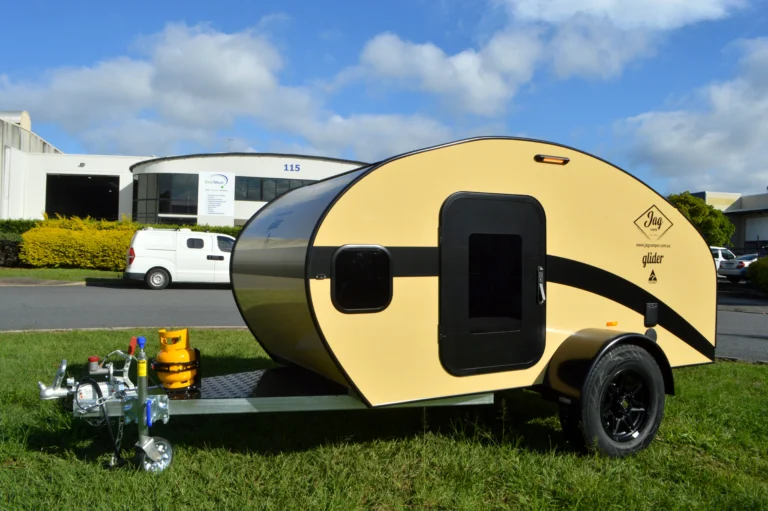
For buyers with a 750kg braked tow vehicle, the JAG Glider is the JAG model to look at first because it is the lightest direction in the range. The JAG Teardrop Camper is likely to need a vehicle with more towing margin once loaded, depending on the exact vehicle and setup.
That distinction is important. A useful seller should not push every model at every tow vehicle. The right approach is to start with the vehicle limits, estimate the loaded trip weight, then match the camper.
Pre-purchase checklist for 750kg tow vehicles
- Confirm the car’s braked and unbraked towing capacity.
- Confirm tow ball download limit.
- Confirm towbar rating.
- Choose a camper with real loaded margin below 750kg.
- Check whether trailer brakes are fitted and suitable.
- Weigh the camper packed for a normal trip.
- Keep heavy gear out of the camper if it pushes you over the limit.
- Avoid buying anything that only works if tanks are empty and gear is minimal.
Useful sources
FAQ
Can I tow a 750kg camper with a 750kg braked tow rating?
Only if 750kg is the loaded trailer weight and all other limits also fit. In practice, you should leave margin rather than aiming for the exact maximum.
Is 750kg braked the same as 750kg unbraked?
No. Braked towing assumes the trailer has suitable brakes. Your vehicle’s unbraked towing capacity may be lower.
What is the best camper for 750kg braked towing?
Usually a genuinely ultra-light camper with low loaded weight and manageable ball weight. Start with measured weights, not marketing terms.

