
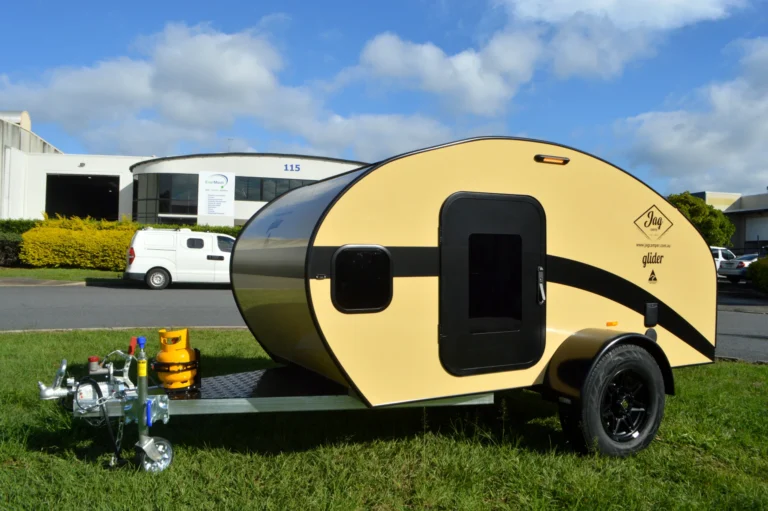
An off-road teardrop camper should be judged by more than a tough-looking photo. Clearance, suspension, tyres, chassis protection, sealing, brakes, loaded weight and real trip expectations all matter. The phrase “off-road” can mean anything from graded dirt roads to rough tracks, so buyers need to ask specific questions.
After reading this guide, you should be able to look past the label and check whether an off-road teardrop camper suits the kind of tracks you actually plan to travel.
Quick answer
A good off-road teardrop camper should have the structure, suspension, clearance, tyres, braking and sealing to handle the roads you intend to use. It should also stay within your tow vehicle’s loaded towing limits. Off-road capability is not only about toughness. It is about the whole combination surviving corrugations, dust, water, weight and repeated use.
What to check first
| Area | Why it matters | Buyer check |
|---|---|---|
| Suspension | Controls wheel movement and ride over rough surfaces | Ask what suspension is fitted and why |
| Ground clearance | Reduces scraping on ruts, entries and exits | Check lowest points, not just body height |
| Tyres and wheels | Affect grip, puncture resistance and spares | Check size, load rating and spare compatibility |
| Chassis and body | Repeated vibration can expose weak builds | Ask about material, protection and mounting points |
| Sealing | Dust and water ingress ruin trips | Inspect doors, hatches, vents and kitchen openings |
| Brakes | Loaded downhill control matters | Check brake type and controller requirements |
Worked example: off-road claim vs real trip
Imagine two campers both advertised as off-road.
| Check | Camper A | Camper B |
|---|---|---|
| Tare and ATM | Light with useful payload | Heavy once options are added |
| Suspension | Known off-road suspension system | Generic claim with little detail |
| Clearance | Good clearance at chassis and rear | Low plumbing or rear step |
| Dust sealing | Sealed doors and hatches | Unclear sealing detail |
| Recovery/support | Clear advice and local support | Seller cannot explain limits |
Both might handle a smooth dirt road. Only one gives you enough information to judge repeated rough-road use. The useful question is not “is it off-road?” It is “what kind of off-road use was it designed for, and what are its limits?”
What off-road does not mean
- It does not mean you can ignore tow vehicle limits.
- It does not mean every track is suitable.
- It does not mean water crossings are automatically safe.
- It does not mean weight no longer matters.
- It does not mean the camper is immune to dust, vibration or poor packing.
Questions to ask the seller
- What terrain was this camper designed for?
- What suspension is fitted?
- What is the ground clearance at the lowest point?
- Where are plumbing, wiring and tanks protected?
- How are doors, hatches and kitchen openings sealed?
- What tyres and wheel bearings are used?
- What loaded tow ball weight should I expect?
- What maintenance is recommended after rough-road travel?
- What use is excluded from warranty?
What to check on your tow vehicle
RACQ explains that towing limits and towbar ratings both matter. Off-road buyers also need margin because rough roads, hills, heat and recovery situations are harder on the whole setup than a flat sealed-road tow.
- Braked towing capacity.
- Tow ball download limit.
- Vehicle payload and GVM.
- Towbar rating.
- Tyres suitable for the roads you plan to use.
- Recovery points and basic recovery equipment.
- Spare tyre compatibility and repair gear.
Common off-road teardrop mistakes
- Buying the look. Black guards and aggressive tyres do not prove capability.
- Ignoring loaded weight. Water, batteries and gear still count.
- Forgetting sealing. Dust can be more annoying than rough suspension.
- Not checking the lowest point. Clearance is only as good as the lowest vulnerable part.
- Assuming warranty covers everything. Ask what use is excluded.
Where JAG fits
The JAG Glider and JAG Teardrop Camper are built around lightweight teardrop touring rather than full-size caravan weight. JAG’s off-road positioning should still be matched to the buyer’s tow vehicle, loaded weight, terrain and expectations. The right conversation is about real use, not just a badge.
Off-road buyer checklist
- Define the roads you actually plan to use.
- Check suspension, clearance, tyres and brakes.
- Inspect sealing around every door and hatch.
- Check where tanks, plumbing and wiring sit.
- Confirm loaded weight and ball weight.
- Ask about warranty limits and maintenance.
- Carry spares and know your recovery limits.
- Leave towing margin rather than running at the edge.
FAQ: off-road teardrop campers
Is every teardrop camper off-road?
No. Some are best for sealed roads and campgrounds. Check suspension, clearance, sealing, tyres, chassis protection and manufacturer guidance.
Do off-road campers need to be heavy?
No. Strength matters, but unnecessary weight can make towing harder. The goal is the right structure and components without wasting payload.
What is the most overlooked off-road feature?
Dust sealing. Buyers often focus on suspension and tyres, but poor sealing can make dirt-road touring miserable.

