
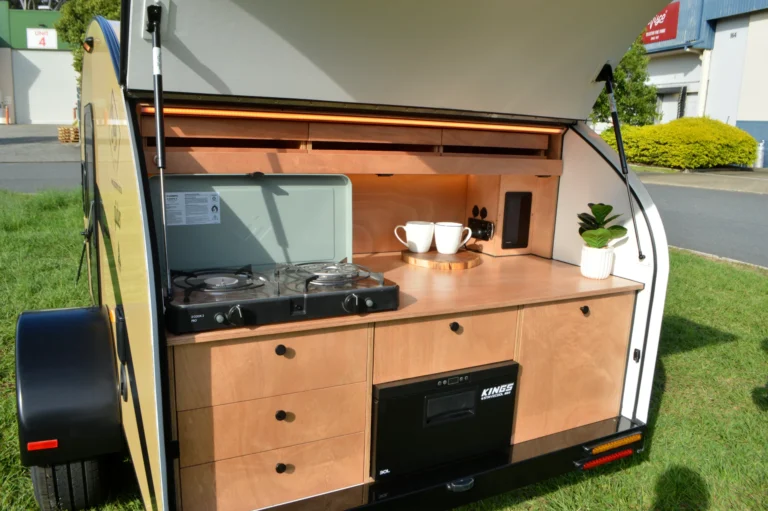
Quick answer: with a 1000kg towing capacity, you should usually look for a camper that stays comfortably under 1000kg when fully loaded, not one that is 1000kg empty. The real decision comes down to loaded weight, tow-ball weight, trailer brakes, towbar rating and payload in the vehicle.
A 1000kg tow rating can be enough for lightweight teardrops and some compact camper trailers. It is usually not enough for a full-sized caravan once water, food, batteries, awnings and gear are included. The mistake buyers make is treating the tow rating like a shopping category instead of a limit.
After reading this, you should be able to shortlist campers that suit a 1000kg tow vehicle and know what to ask before buying.
What 1000kg towing capacity actually means
The vehicle manufacturer sets the maximum trailer weight the car can tow. If the rating says 1000kg braked, that generally means the loaded trailer must stay at or below 1000kg and have suitable brakes. It does not mean every 1000kg camper is a good idea, and it does not override the towbar rating, ball weight limit or payload limit.
| Number | What it tells you | Why it matters |
|---|---|---|
| Braked towing capacity | Maximum loaded trailer weight with trailer brakes | The packed camper must fit below this. |
| Unbraked towing capacity | Maximum loaded trailer weight without trailer brakes | Often much lower than the braked limit. |
| Tow-ball download | Downward load on the towbar | Can overload a small SUV before trailer weight does. |
| Vehicle payload | Weight the car can carry | Passengers, luggage, accessories and ball weight all count. |
| Camper ATM | Maximum legal loaded camper weight | Shows how heavy the camper can become when packed. |
A sensible shortlist range
For a 1000kg tow vehicle, the safest shortlist is usually campers that can be loaded for a normal trip somewhere around 750-900kg, depending on the car, ball weight and trip gear. That gives you breathing room for food, water, bedding, tools and small packing mistakes.
A camper with a 980kg tare leaves almost no useful payload margin. A camper with a much lower tare and honest payload is usually a better match, even if both appear under 1000kg in a search filter.
Worked example: the 860kg camper trap
Imagine a camper with an 860kg tare. It sounds comfortable under 1000kg. Then you pack 60L of water, food, bedding, clothes, camp chairs, tools, hoses and a few accessories. That can easily add 120-180kg.
| Load item | Approximate weight |
|---|---|
| 60L water | 60kg |
| Food and pantry | 25-35kg |
| Bedding and clothes | 25-40kg |
| Camp furniture and shade | 25-50kg |
| Tools, leads and hoses | 15-30kg |
That 860kg camper can become 1010kg or more if you are not careful. If your vehicle limit is 1000kg, you are already out of room. This is why weighbridge checks and realistic packing matter.
What camper styles suit a 1000kg tow vehicle?
| Camper style | Fit with 1000kg tow capacity | Watch out for |
|---|---|---|
| Ultra-light teardrop | Usually strong fit | Check loaded weight and ball weight. |
| Compact camper trailer | Often possible | Canvas, batteries and water add up. |
| Small pop-top | Possible but tight | Many exceed 1000kg loaded. |
| Full-height caravan | Usually poor fit | Weight, drag and ball load. |
| Heavy off-road camper | Usually unsuitable | Chassis, suspension and protection add weight. |
Tow-ball weight can be the real limit
A 1000kg tow rating does not help if the tow-ball weight is too high for the vehicle. Ball weight presses down on the rear of the car and counts against payload. If the vehicle has a low ball limit, a camper can be unsuitable even when total trailer weight looks fine.
Ask the seller for measured ball weight in a realistic loaded setup. Then compare it with your owner’s manual and towbar plate. Do not rely on a rough percentage.
Common mistakes with 1000kg tow vehicles
- Buying a camper too close to the limit. A 990kg loaded camper leaves almost no room for weighbridge variation or changed packing.
- Assuming the car payload is separate. Tow-ball weight presses on the car and reduces what you can carry inside it.
- Forgetting accessories. Spare wheels, storage boxes, second batteries, awnings and roof loads can all shift the final number.
- Not checking brake requirements. A trailer that needs brakes must have a suitable braking setup for the vehicle and trailer.
- Trusting “lightweight” without proof. Ask for actual weight data, not just a marketing claim.
Questions to ask before buying
- What is the camper’s tare, ATM and GTM?
- What is the measured loaded weight with common options?
- What is the measured tow-ball weight?
- Are brakes fitted, and what type?
- How much payload remains after water, batteries and awnings?
- Can I see a compliance plate or weighbridge ticket?
- What loaded weight should I plan for on a normal weekend away?
Where JAG fits
For a 1000kg tow vehicle, JAG’s lighter camper options are the ones to compare first. The JAG Glider gives the most towing margin in the range. The JAG Teardrop Camper may suit some 1000kg-rated vehicles if the loaded weight, ball weight and vehicle payload all check out.
The right answer depends on the actual car. Bring the vehicle manual data when comparing campers so the conversation starts with limits, not guesses.
Pre-purchase checklist
- Confirm braked and unbraked towing capacity.
- Confirm towbar and tow-ball download limits.
- Estimate loaded camper weight, not tare.
- Estimate loaded vehicle payload with passengers and luggage.
- Choose a camper with margin below 1000kg.
- Weigh the camper packed for a normal trip.
- Avoid combinations that only work with empty tanks and minimal gear.
Useful sources
FAQ
Can I tow a 1000kg camper with a 1000kg tow rating?
Only if 1000kg is the loaded trailer weight and every other limit also fits. In practice, leave margin below the maximum.
Is 1000kg towing capacity enough for a caravan?
Usually not for a conventional full-height caravan, but it can suit lightweight teardrops and compact campers if the loaded weight stays within limits.
Should I shop by tare or ATM?
Use both, but make the final decision on realistic loaded weight, payload and ball weight.

