
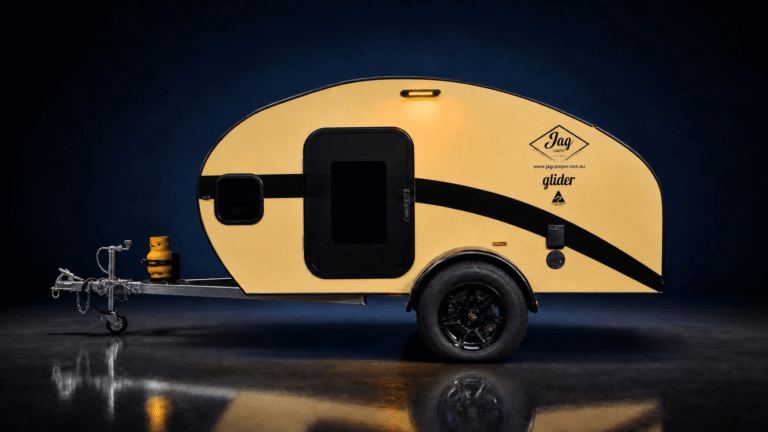
Quick answer: a 550kg camper trailer is for buyers who want very easy towing, compact storage and fast trips, especially with small SUVs, hybrids, EVs or daily-driver cars. It is not for buyers who need full caravan space, an internal ensuite or huge payload.
The appeal of a 550kg camper is not only that more vehicles may be able to tow it. It is that the whole camping routine becomes lighter: easier to move at home, easier to reverse, easier to store, easier to take away for one night, and less intimidating for new towers.
After reading this, you should know whether an ultra-light camper fits your travel style, what trade-offs to expect, and what weight checks still matter.
Who a 550kg camper suits
| Buyer type | Fit | Why |
|---|---|---|
| Solo traveller | Strong | Easy setup and towing without needing a big vehicle. |
| Couple doing weekends | Strong | Enough comfort if you pack simply and live outdoors. |
| Small SUV owner | Often strong | Lower loaded weight gives more towing margin. |
| EV or hybrid owner | Often strong | Low weight and compact shape can help range and towing feel. |
| Family touring long-term | Usually weak | Storage and sleeping capacity may be too limited. |
| Buyer wanting ensuite/indoor lounge | Poor | That is conventional caravan territory. |
The real trade-off: simplicity vs space
Ultra-light campers work best when the buyer values simplicity. You get easier towing and quicker getaways, but you give up the big indoor living space of a caravan. For many people, that is a good trade. They want a comfortable bed, practical storage, a simple kitchen setup and less hassle on the road.
For others, it is the wrong trade. If you want to stand inside, cook inside, shower inside and carry bulky gear for long trips, a 550kg camper may feel too small. The point is to be honest about your normal trips.
Worked example: why 550kg gives margin
Imagine a vehicle rated to tow 1000kg braked. A camper starting around 550kg leaves much more room for water, bedding, food and gear than a camper starting near 900kg. That margin can be the difference between a relaxed setup and one that needs perfect packing every trip.
| Starting camper weight | Add 180kg trip load | Result |
|---|---|---|
| 550kg | 730kg loaded | Useful margin for many tow vehicles. |
| 750kg | 930kg loaded | Still possible for some vehicles, but tighter. |
| 900kg | 1080kg loaded | Over a 1000kg tow limit. |
This is simplified, but it shows the buying logic. Starting lighter does not remove the need to check loaded weight and ball weight, but it gives you a better chance of staying inside limits.
A realistic weekend with a 550kg camper
The best use case is a simple weekend away. You leave Friday afternoon, tow with the same car you use during the week, park in a normal campsite, open the camper, set up a small kitchen or awning, and sleep in a proper bed instead of a tent. Pack-up on Sunday is quick enough that the trip still feels worthwhile.
That is where ultra-light campers shine. They reduce the friction around camping. You do not need a big tow vehicle, a huge storage bay at home, or a full afternoon to set up. The trade-off is that you need to pack deliberately and accept that most living happens outside.
Storage reality check
Before choosing a 550kg camper, list the bulky items you refuse to leave behind: chairs, table, fridge, bedding, portable toilet, recovery gear, dog gear, kids gear, fishing gear or bikes. If that list is long, the camper may still tow beautifully but not suit your habits.
This is not a negative. It is the point of comparing properly. A 550kg camper is best for buyers who want the benefits of travelling light and are willing to keep the kit simple.
What to check even with a 550kg camper
- Loaded weight after water, food, bedding and gear.
- Tow-ball weight in a normal packed setup.
- Vehicle braked and unbraked towing capacity.
- Vehicle payload after passengers, luggage and ball weight.
- Whether brakes are fitted or required for the loaded setup.
- Payload remaining after options and accessories.
Common mistakes with ultra-light campers
- Assuming light means unlimited packing. Payload still matters.
- Buying too small for your habits. If you overpack every trip, the camper may frustrate you.
- Ignoring comfort trade-offs. Very light campers usually have less indoor space.
- Skipping vehicle checks. Some small cars still have limited tow ratings.
- Adding heavy accessories later. The weight advantage can shrink quickly.
Where JAG fits
The JAG Glider is JAG’s ultra-light option and the most relevant model for buyers researching a 550kg camper trailer in Australia. It suits people who want easier towing and a simpler camper, while still choosing an Australian-made product. Buyers who want more teardrop comfort can also compare the JAG Teardrop Camper, but should check vehicle margin carefully.
Questions to ask before buying
- Is 550kg the tare, ATM or approximate model weight?
- What is the loaded weight with common options?
- How much payload is available?
- What is the measured tow-ball weight?
- What gear do I need to carry for my normal trips?
- Will I miss indoor space or an ensuite?
- Can I inspect the storage layout in person?
Useful sources
FAQ
Can a 550kg camper be towed by a small car?
Sometimes, but only if the exact car’s towing, ball weight and payload limits allow it. Check the manual first.
Is 550kg enough camper for two people?
For many weekend couples, yes, if they are happy with compact storage and outdoor living. It is not a full caravan replacement.

