
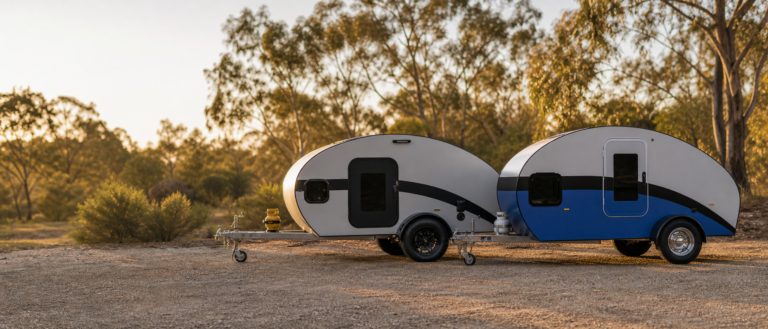
Quick answer: an easy-to-tow camper trailer is light enough for your vehicle when loaded, balanced on the tow ball, low enough to reduce drag, fitted with suitable brakes where required, and simple enough to manoeuvre, reverse and store.
“Easy to tow” gets used a lot in camper marketing, but it should mean something specific. A camper is not easy to tow just because it is small, and it is not automatically difficult because it has features. The real answer comes from weight, shape, balance, brakes, vehicle match and how the camper behaves in normal driving.
After reading this, you should have a practical checklist for comparing campers and spotting whether “easy to tow” is backed by useful details.
The easy-to-tow checklist
| Check | Good sign | Warning sign |
|---|---|---|
| Loaded weight | Comfortably below your vehicle’s tow rating | Close to the limit before packing. |
| Tow-ball weight | Measured and within vehicle limit | Unknown or only estimated. |
| Payload | Enough for real gear and water | Only works with minimal packing. |
| Shape | Low profile and compact | Tall, wide and blunt behind a small car. |
| Brakes | Suitable for loaded weight and vehicle setup | Brake requirements unclear. |
| Storage at home | Fits where you will keep it | Too large to move or store easily. |
Weight is the starting point, not the whole story
Lower weight usually helps, especially for smaller tow vehicles. But a camper can be light and still tow poorly if the load is badly balanced, the ball weight is wrong, tyres are neglected or the camper is too tall for the vehicle. Use weight as the first filter, then check the rest of the combination.
Worked example: two campers under the same tow rating
Imagine your vehicle is rated to tow 1000kg. Camper A weighs 920kg loaded, has unknown ball weight and is tall. Camper B weighs 730kg loaded, has a measured ball weight within your vehicle limit and is low-profile. Both may appear to fit the towing capacity, but Camper B is likely to be easier to live with.
This is why “under the tow rating” is not enough. The better camper is the one with margin, proof and predictable behaviour.
What easy towing feels like
- The vehicle accelerates and brakes without feeling strained.
- The camper tracks cleanly behind the car.
- Reversing into a normal campsite is manageable.
- Crosswinds and passing trucks are not unnerving.
- The camper does not overload the rear of the vehicle.
- Setup and pack-up are simple enough that short trips still feel worthwhile.
How to test whether it really is easy to tow
If possible, test tow the camper before committing. A useful test is not just a lap around the block. You want to feel take-off, braking, a roundabout, a short hill, a highway section, reversing and low-speed manoeuvring. Pay attention to whether the car feels settled or whether the camper is controlling the drive.
Also check practical handling when stationary. Can you move it around the driveway? Can you see around it with mirrors? Can you reverse it into the kind of campsite you actually book? Can you store it without needing help every time? These everyday details often decide whether a camper gets used often.
Easy-to-tow decision guide
| If this is true | What it usually means |
|---|---|
| You are new to towing | Prioritise low loaded weight, compact length and simple reversing. |
| Your vehicle is close to its limits | Choose a lighter camper or reduce gear; do not rely on perfect packing. |
| You do frequent weekend trips | Fast hookup, storage and pack-up matter as much as road towing. |
| You tow long highway distances | Shape, tyre condition, brakes and stability become more important. |
| You camp in tight sites | Compact width, visibility and manoeuvrability matter. |
Questions to ask a seller
- What is the tare, ATM and typical loaded weight?
- What is the measured tow-ball weight?
- How much payload remains after common options?
- What brake setup is fitted or required?
- How tall and wide is the camper in travel mode?
- Has it been matched with vehicles like mine?
- Can I test tow or see a handover explanation of loading?
Common “easy to tow” traps
- Only quoting tare. Buyers tow the loaded camper.
- Using vague words instead of numbers. Ask for measured weight and ball weight.
- Ignoring the tow vehicle. A camper that suits one car may not suit another.
- Forgetting payload. Gear and water can change the setup.
- Assuming small means stable. Balance and loading still matter.
- Buying for one big trip. Easy towing matters most on the trips you actually take often.
Where JAG fits
JAG’s lightweight teardrop campers are designed for buyers who want the camper to feel manageable, not like a major towing project. The JAG Glider is the easiest JAG starting point for very light towing. The JAG Teardrop Camper adds more teardrop comfort while staying compact compared with a conventional caravan.
The best next step is still to match the exact model and options to the exact tow vehicle. Easy towing comes from the combination, not the camper alone.
Pre-buy checklist
- Confirm your vehicle’s towing and payload limits.
- Check towbar and ball-weight limits.
- Compare loaded camper weight, not just tare.
- Ask for measured ball weight.
- Check brake requirements and wiring.
- Think about storage and reversing at home.
- Do not accept “easy to tow” unless the seller can explain why.
Useful sources
FAQ
What makes a camper easy to tow?
Low loaded weight, sensible ball weight, compact shape, suitable brakes and a good match with the tow vehicle.
Are teardrop campers easy to tow?
Often, yes, because they are usually lower and lighter than full caravans. The exact loaded weight and tow vehicle still need checking.

