Quick answer: camper trailer payload is the weight allowance left for everything you add after the camper’s tare weight: water, food, clothes, bedding, batteries, tools, hoses, camp furniture and options. A camper with too little payload can be overloaded even when it looks lightweight.
Payload is one of the most useful numbers in camper buying because it shows whether the camper suits real life. A low tare is great, but not if the payload is so small that you cannot pack for the trips you actually take.
After reading this, you should be able to estimate your camping load, compare payload between campers and ask sellers for the numbers that matter.
How camper trailer payload is calculated
Payload is usually the difference between the camper’s ATM and tare. If a camper has a 600kg tare and a 900kg ATM, the payload is 300kg. That payload is not just for luggage. It must cover every item added after the tare measurement.
| Number | Example | What it means |
|---|---|---|
| Tare | 600kg | Empty camper weight as specified. |
| ATM | 900kg | Maximum loaded trailer weight. |
| Payload | 300kg | Weight available for water, gear and options. |
| Loaded weight | Must stay at or below ATM | The number you tow on the road. |
Worked example: where payload goes
Here is a realistic weekend load for two people. Your numbers may differ, but this shows why payload can disappear quickly.
| Item | Approximate weight |
|---|---|
| 80L water | 80kg |
| Food, pantry and drinks | 30kg |
| Bedding and clothes | 35kg |
| Camp chairs, table and shade | 40kg |
| Tools, leads, hoses and levelling gear | 25kg |
| Portable toilet or extra camp gear | 10-25kg |
That load can already be 220kg or more. If the camper only has 180kg of payload, you either need to pack less, carry some gear in the vehicle if payload allows, reduce water, or choose a camper with more payload.
Payload mistakes buyers make
- Only comparing tare. A low tare is useful, but payload tells you whether the camper can carry your gear.
- Forgetting water weight. One litre is roughly one kilogram.
- Ignoring options. Batteries, awnings, hot water, spare wheels and storage boxes may reduce remaining payload.
- Moving everything into the car. The vehicle also has payload limits, and tow-ball weight counts there too.
- Never weighing the loaded camper. Guessing is how overloads happen.
Build your own payload estimate
Before buying, make a simple list of what you pack for a normal trip. Do not use a dream version where everyone packs lightly. Use the real version: the extra jacket, the second chair, the bigger esky, the toolbox, the dog gear, the kids’ bedding and the food you always add at the last minute.
- Start with fixed camper options: batteries, awning, spare wheel, storage boxes, hot water and solar.
- Add consumables: water, gas, food and drinks.
- Add soft gear: bedding, clothes, towels and jackets.
- Add campsite gear: chairs, table, mats, shade, lights and cooking gear.
- Add safety and service gear: tools, hoses, leads, levelling ramps, first-aid kit and recovery basics.
Then compare that estimate with the payload left after options. If the result only works with empty water tanks or no spare gear, the camper may be too tight for your style of camping.
Payload and tow-ball weight are connected
Where you place payload also matters. Heavy items forward can increase tow-ball weight. Heavy items behind the axle can reduce ball weight but may affect stability if loaded badly. The goal is not just staying under ATM; it is keeping the camper balanced and the tow vehicle inside its payload and ball-weight limits.
If you regularly change your load, weigh the camper in the setup you actually use. For a long trip, a weighbridge check is cheap compared with travelling overloaded.
What payload is enough?
There is no one perfect payload number. A couple doing short powered-site weekends may need far less payload than someone carrying full water, recovery gear, solar, tools and remote-camping supplies. The right payload depends on your camping style.
| Camping style | Payload need | Why |
|---|---|---|
| Short caravan-park weekends | Lower | Less water, fewer tools, easier resupply. |
| National-park weekends | Moderate | More water, food and self-sufficient gear. |
| Remote touring | Higher | Water, spares, recovery gear and power add weight. |
| Family camping | Higher | More clothes, bedding, food and camp furniture. |
Questions to ask the seller
- What is the tare and ATM?
- How much payload remains after fitted options?
- What items are included in the tare figure?
- How much do common accessories add?
- What is the measured ball weight when loaded?
- Can I see a weighbridge ticket or compliance plate?
- Where should heavy gear be packed for safe balance?
Where JAG fits
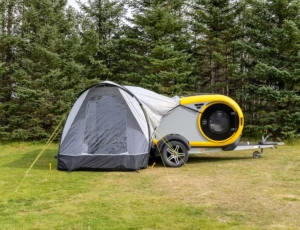
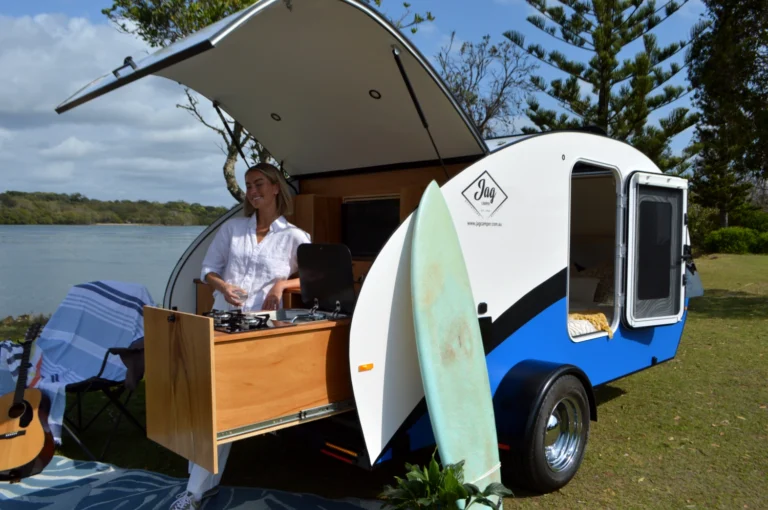
JAG buyers should think about payload in terms of their normal trips. The JAG Glider suits buyers wanting a very light towing setup, while the JAG Teardrop Camper gives more teardrop comfort. In both cases, current tare, ATM, options and loaded packing style should be checked against the tow vehicle.
Payload checklist
- List the gear you actually take camping.
- Add water weight separately.
- Ask how options affect remaining payload.
- Check vehicle payload as well as camper payload.
- Keep a repeatable packing method.
- Visit a weighbridge before a major trip.
- Do not buy a camper that only works if you leave important gear behind.
Useful sources
FAQ
Is payload the same as storage space?
No. Storage space is volume. Payload is weight allowance. A camper can have room for gear but not enough legal payload to carry it.
Does water count as payload?
Yes. Water carried in the camper counts toward loaded weight and payload.