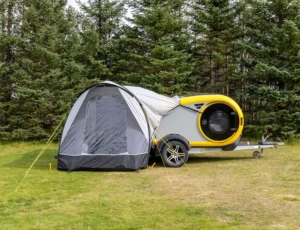
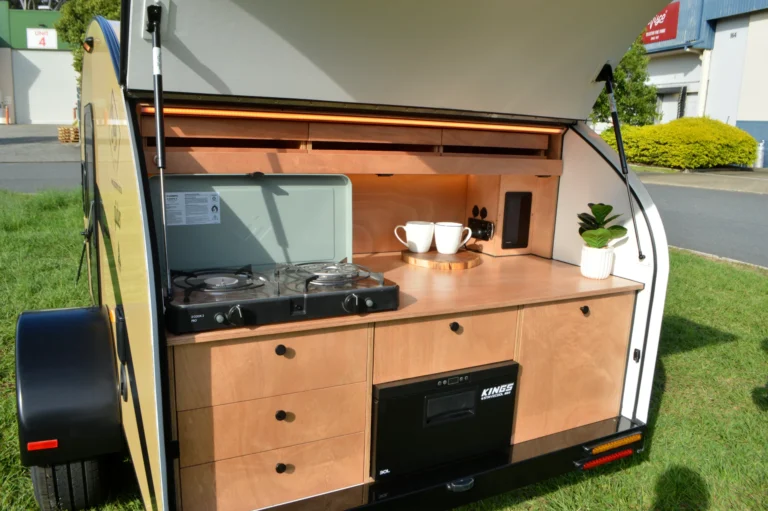
The Suzuki Jimny is rated to tow more than many people expect, but that does not mean it should be matched with the heaviest camper the brochure allows.
Quick answer: the current Suzuki Jimny has a 1,200kg braked towing capacity, but realistic camper towing should sit well below that. For efficient, comfortable touring, a Jimny camper should ideally be around 500kg tare, around 50kg tow-ball weight, and no more than about 750kg loaded with a 75kg loaded tow-ball ceiling.
That is the zone where the Jimny makes sense. Above that, the small engine, short wheelbase and light vehicle weight start to matter.
The legal number vs the useful number
The 1,200kg braked towing capacity is the legal headline. It is not the ideal touring target.
There is a big difference between:
- A trailer the Jimny is technically rated to tow
- A camper the Jimny can tow comfortably on real Australian roads
The second one is the better buying target.
For a camper, the Jimny has to deal with more than mass. It has to deal with wind drag, hills, hot days, water onboard, recovery gear, food, bedding, fridge contents, passengers and whatever is packed inside the vehicle.
That is why a low-profile camper around 500kg tare is far more realistic than a boxier or heavier camper that creeps toward the 1,200kg maximum.
Practical Jimny camper targets
| Target | Recommended range |
|---|---|
| Ideal camper tare | Around 500kg |
| Practical loaded camper target | Up to about 750kg |
| Ideal tow-ball weight | Around 50kg |
| Maximum loaded tow-ball target | 75kg |
| Camper shape | Low-profile and aerodynamic |
| Camper width | Compact enough to sit comfortably behind the Jimny |
These targets create margin. Margin matters because the Jimny is not a big diesel 4WD with a long wheelbase and huge torque reserve. It is a small, light, capable 4WD that works best when the camper is matched to its strengths.
Why loaded weight matters more than tare
Tare is the camper’s empty weight. It is useful for shortlisting, but it is not what you tow on a trip.
A realistic packed camper may include:
| Item | Approximate added weight |
|---|---|
| 60L water | 60kg |
| Food and cookware | 20kg |
| Bedding and clothes | 25kg |
| Chairs, table and shade | 25kg |
| Tools, hoses and leads | 20kg |
| Fridge contents and loose gear | 30kg |
That is about 180kg before you start adding heavier options.
So a 550kg camper can become roughly 730kg loaded. That still sits in the sensible Jimny zone.
An 850kg camper can become 1,030kg loaded. A 950kg camper can become 1,130kg loaded. Those numbers may sit under the 1,200kg rating, but they are much less realistic if the aim is efficient, relaxed touring.
Why tow-ball weight is the hidden limiter
Tow-ball weight matters because it sits on the back of the Jimny. With a maximum tow-ball target of 75kg, a camper that starts around 50kg empty gives useful room for real packing.
A camper that starts at 75kg empty can exceed the limit once water, food, gas, fridge contents or front storage are loaded. That is why the ball-weight target should be conservative from the start.
For Jimny owners, the best camper is not only light overall. It also needs a sensible balance.
Mega Jimny’s towing guide explains this through the 10% tow-ball guideline. A 750kg loaded trailer with 75kg on the ball sits at roughly 10%. That is a useful real-world rule of thumb because it supports trailer stability while staying inside the Jimny’s ball-weight limit.
This is also why heavier campers become a problem. If a camper weighs 1,000kg loaded, a 10% ball-weight guideline would point toward about 100kg on the ball, which is above the Jimny target. Trying to keep that heavier camper at 75kg ball weight may leave the trailer too light on the ball.
Why the JAG Glider was designed around this
The JAG Glider fits the realistic Jimny towing brief because it was designed around small-vehicle numbers, not large-4WD numbers.
JAG lists the Glider at 550kg tare and 50kg ball weight. Those are the kinds of figures that make sense behind a Jimny because they leave room for real camping gear while keeping the camper in the efficient towing zone.
The point is not just that the Glider fits under the Jimny’s rating. The point is that it avoids making the Jimny work at the top of its range all the time.
That is exactly what Jimny owners should be looking for.
The Glider is also off-road friendly, which is important because many Jimny owners are not just towing to caravan parks. If the plan includes dirt roads, corrugations or off-road tracks, the camper’s weight and suspension become even more important. A camper that feels acceptable on smooth bitumen can feel completely different when it is loaded, bouncing and pulling behind a small 4WD on uneven ground.
Other campers in the same weight lane
There are not many enclosed campers that sit in the right Jimny zone, but Little Guy Australia is worth including in the comparison set.
Little Guy lists the Deluxe at 380kg tare, 470kg fully optioned, 538kg ATM and 38kg ball weight. The Deluxe Plus is listed at 420kg tare, 520kg fully optioned, 595kg ATM and 45kg ball weight. The Cruiser is listed at 450kg tare, 548kg fully optioned, 648kg ATM and 48kg ball weight.
Those numbers fit the realistic Jimny lane well. They also make the comparison more useful because buyers can see that the target is not imaginary: the right style of compact teardrop can stay well under 750kg loaded.
The Little Guy Rough Rider is more borderline for this specific article. It is listed at 550kg tare, 646kg fully optioned, 814kg ATM and 64kg ball weight. That may suit some small-vehicle buyers, but it moves past the clean 750kg loaded target, so it should not be treated as a first-choice Jimny recommendation.
What camper types should Jimny owners avoid?
Avoid campers that:
- Start around 850kg to 1,000kg tare
- Have 100kg-plus tow-ball weight
- Have an ATM well above the practical Jimny zone
- Are tall and boxy
- Are designed mainly for dual-cab utes or large 4WDs
- Need lots of heavy options to become comfortable
- Have vague or missing ball-weight information
- Have suspension or construction that does not suit the tracks you actually want to tow on
Even if some of those campers are technically within a 1,200kg braked rating when empty, they are not the right fit for this article or this buyer.
Jimny camper buying checklist
Before buying, confirm:
- Tare is around 500kg to 600kg, not close to one tonne.
- Loaded weight can realistically stay around 750kg.
- Empty ball weight is around 50kg.
- Loaded ball weight can stay at or under 75kg.
- The camper is low-profile and compact.
- The seller can explain tare, ATM, payload and ball weight clearly.
- You can weigh the final camper setup.
- Your exact Jimny and towbar ratings match the plan.
Final recommendation
Use the 1,200kg braked towing capacity as a ceiling, not a target.
For a Suzuki Jimny, the realistic camper match is around 500kg tare, around 50kg tow-ball weight, and about 750kg loaded. That is why the JAG Glider is such a strong fit for this keyword. It has been designed around the numbers a Jimny actually wants.
FAQ
What is the Suzuki Jimny towing capacity?
Suzuki Australia lists the current Jimny with a 1,200kg braked towing capacity.
What camper weight is realistic for a Jimny?
Around 500kg tare and up to about 750kg loaded is a more realistic target for efficient touring.
What tow-ball weight should a Jimny camper have?
Around 50kg empty is ideal, with 75kg as the loaded upper target.
Is the JAG Glider made for Suzuki Jimny towing?
Yes. The JAG Glider has been designed around small-vehicle towing, with 550kg tare and 50kg ball weight.
Related JAG guides
- JAG Glider lightweight camper
- EV-friendly caravans and campers in Australia
- Caravan weights explained: ATM, tare, GTM and payload
- Contact JAG Camper or book a Brisbane factory tour
Sources used
- Suzuki Australia Jimny specifications
- Mega Jimny towing capacity guide
- RACQ trailer and tow vehicle specifications
- Queensland Government towing guidance
- JAG Glider specifications
- Little Guy Deluxe specifications
- Little Guy Deluxe Plus specifications
- Little Guy Cruiser specifications
Self-review note
Usefulness pass moved this from generic towing advice into a clear Jimny-specific framework. The core buyer takeaway is now obvious: do not shop near 1,200kg, shop near 500kg tare / 50kg ball / 750kg loaded. This gives JAG Glider a much stronger and more truthful positioning.