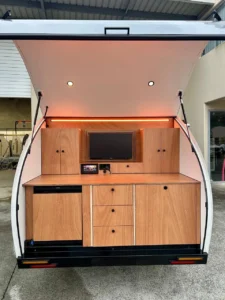
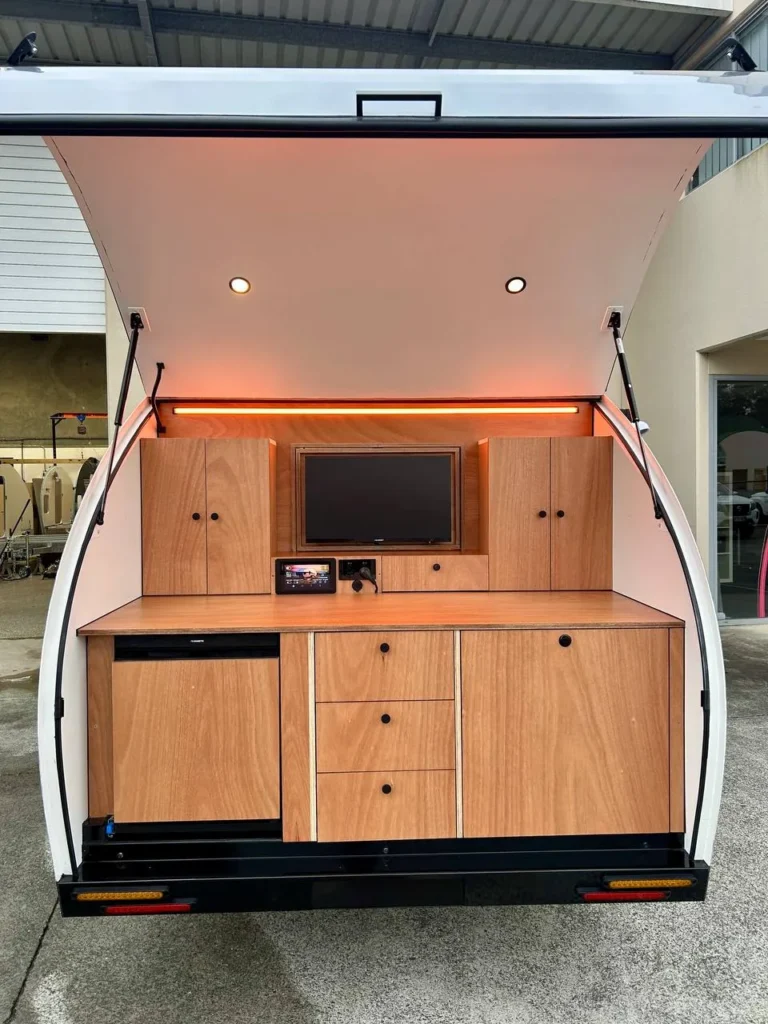
Teardrop Camper Cabinetry: Why JAG Uses Marine Grade Plywood
Why the material behind your cabinetry matters
When you compare teardrop campers, it is easy to focus on the visible features: the kitchen, storage, lighting, mattress and electronics.
But one of the most important decisions is often hidden behind the finish: what the cabinetry is actually made from.
Many imported, pre-assembled teardrop camper cabinetry systems are constructed from MDF with a decorative laminate finish. MDF can be smooth, affordable and attractive when it is new. However, it is also heavy and vulnerable to moisture once water reaches the core.
At JAG Camper, we take a different approach. We use premium marine grade plywood with a UV protective coating, then CNC machine and assemble the cabinetry locally in Brisbane, Australia.
That choice costs more upfront and takes more work, but it gives us a stronger, lighter and more durable foundation for a camper that is expected to handle Australian travel. We believe that buying better materials and construction at the start can save money over the life of the camper, while helping it remain desirable and retain more of its value over time.
What is MDF?
MDF, or medium-density fibreboard, is made by compressing wood fibres with resin and forming them into a flat panel.
It is widely used because it is smooth, consistent and relatively inexpensive. A laminate can then be applied to the surface to create a clean timber-look finish.
The limitation is the MDF core. The laminate is only the outer surface. If moisture reaches an exposed edge, cut-out, screw hole or damaged section, the compressed fibres can absorb water and swell.
Once MDF has swollen, it generally does not return to its original shape. Doors and drawers can become difficult to operate, edges can deteriorate, and fixings can lose strength.
MDF is also a heavy material. In a small camper, unnecessary cabinetry weight reduces the capacity available for equipment, water, food and personal gear.
What is marine grade plywood?
Plywood is made by bonding thin layers of wood veneer together, with the grain direction alternating between layers. This cross-laminated construction gives the panel strength in multiple directions.
Marine grade plywood is made to a higher standard than ordinary interior plywood. It uses suitable veneers, durable bonding and fewer internal voids, making it much more resistant to moisture and separation when properly finished and installed.
Our plywood cabinetry also receives a UV protective coating. The result is a cabinet system with a durable surface and a moisture-resistant structural core.
Marine grade plywood is not a licence to leave timber permanently exposed to water. Edges, joins and penetrations still need to be designed and sealed properly. Material selection and construction quality work together.
Why strength-to-weight ratio matters in a camper
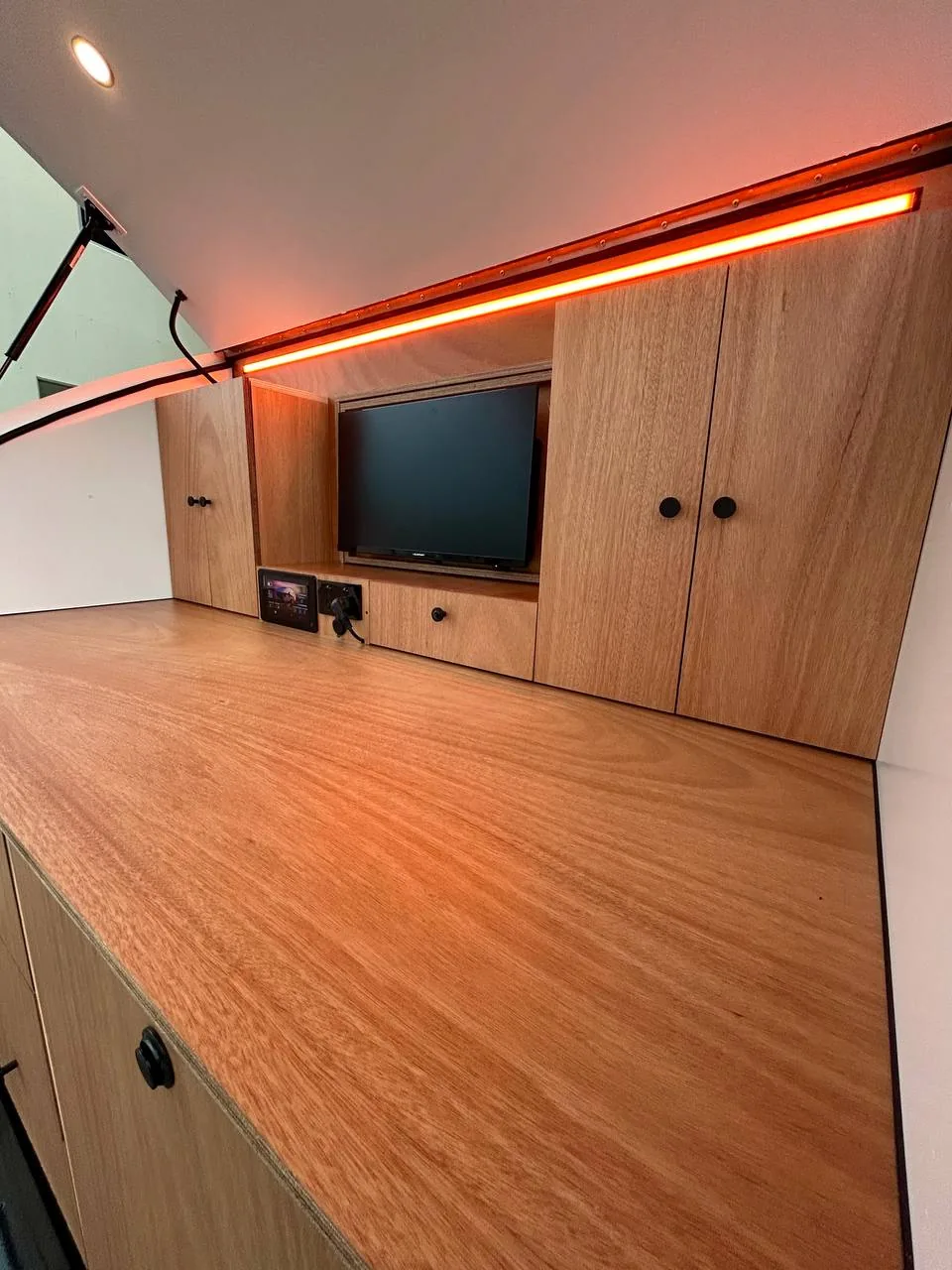
A camper is not a house. Every component travels over bumps, corners, corrugated roads and uneven ground. It must be strong enough for the job without adding unnecessary mass.
Marine grade plywood offers an excellent strength-to-weight ratio compared with MDF. That is one of the reasons we can pack so many features into a JAG Camper while keeping the overall camper light and easy to tow.
The weight savings can be used more effectively for the things people actually take camping: water, food, recovery equipment, clothing, batteries and outdoor gear.
Teardrop camper cabinetry: plywood vs MDF
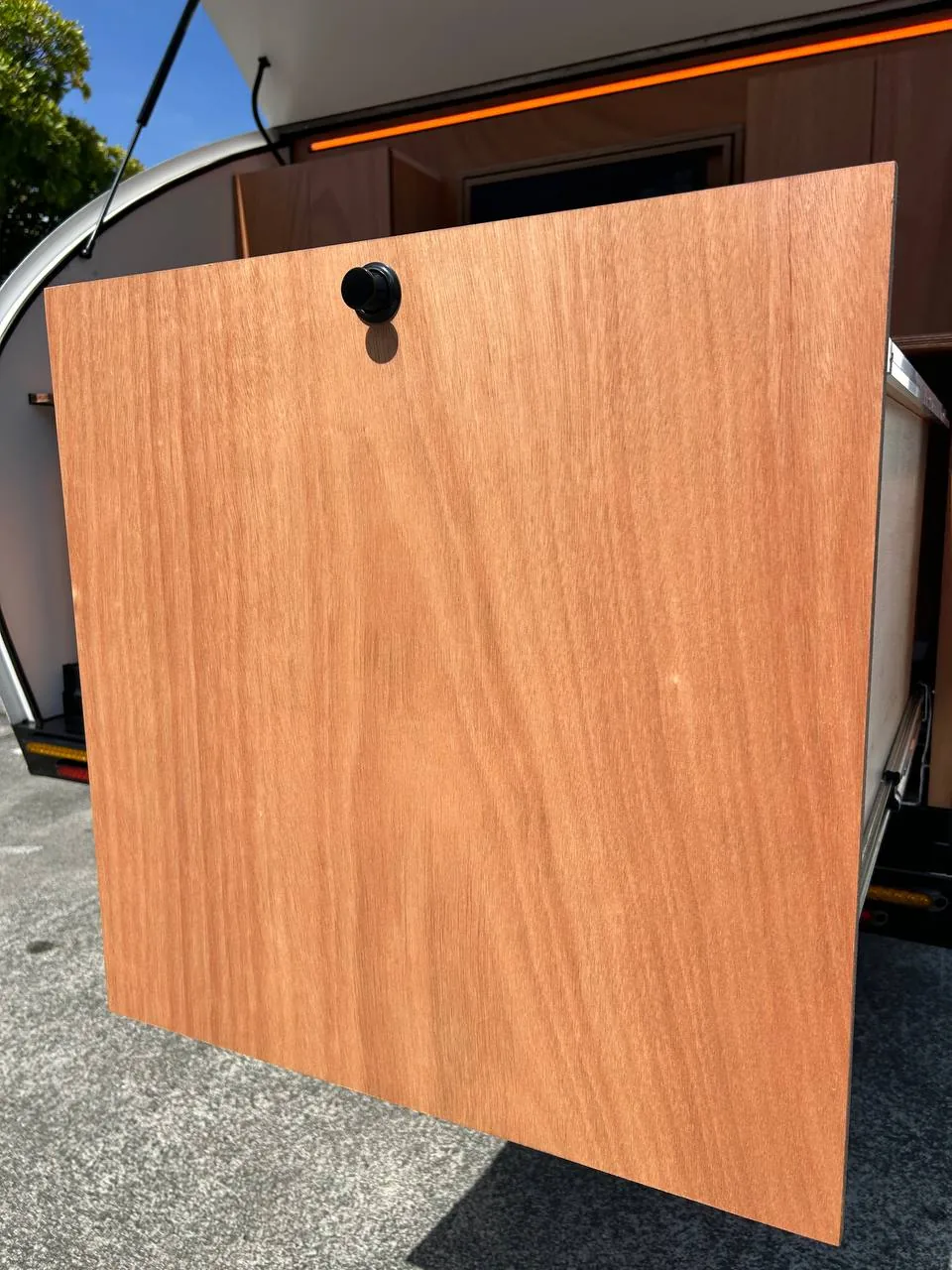
Moisture and humidity
MDF can swell if moisture reaches the core. Humidity, condensation, wet gear and small leaks can all become problems when exposed edges or penetrations are not perfectly protected.
Marine grade plywood is far more moisture-resistant and is better suited to the changing conditions inside a camper. Its layered structure is less vulnerable to the kind of local swelling that can ruin an MDF panel.
Road vibration
Camper cabinetry is continually exposed to vibration. Hinges, drawer runners, fasteners and cabinet joints all need to keep working after many kilometres on the road.
Plywood provides a stronger substrate for fixings and is better suited to this moving environment. MDF can be more prone to crumbling or losing holding strength when fixings are repeatedly loaded, particularly after moisture damage.
Weight
MDF is heavy for the strength it provides. Marine grade plywood gives us a better balance of strength and weight, which matters in a compact camper.
Keeping the cabinetry lighter helps us include more equipment and storage without adding weight that does not improve the camping experience.
Repair and long-term serviceability
Plywood can generally be repaired, re-fastened or refinished more effectively if it is damaged. MDF that has swollen around an edge or fixing may be difficult to restore properly because the material itself has deteriorated.
That matters when a camper is used for years, rather than simply inspected when it is new.
Design flexibility
Because we design and CNC machine the cabinetry ourselves, we can make the components fit the camper precisely. We can account for wiring, plumbing, appliances, storage access, ventilation, fasteners and the shape of the cabin as part of the design.
We are not limited to installing a generic pre-assembled cabinet package.
Local CNC machining and assembly in Brisbane
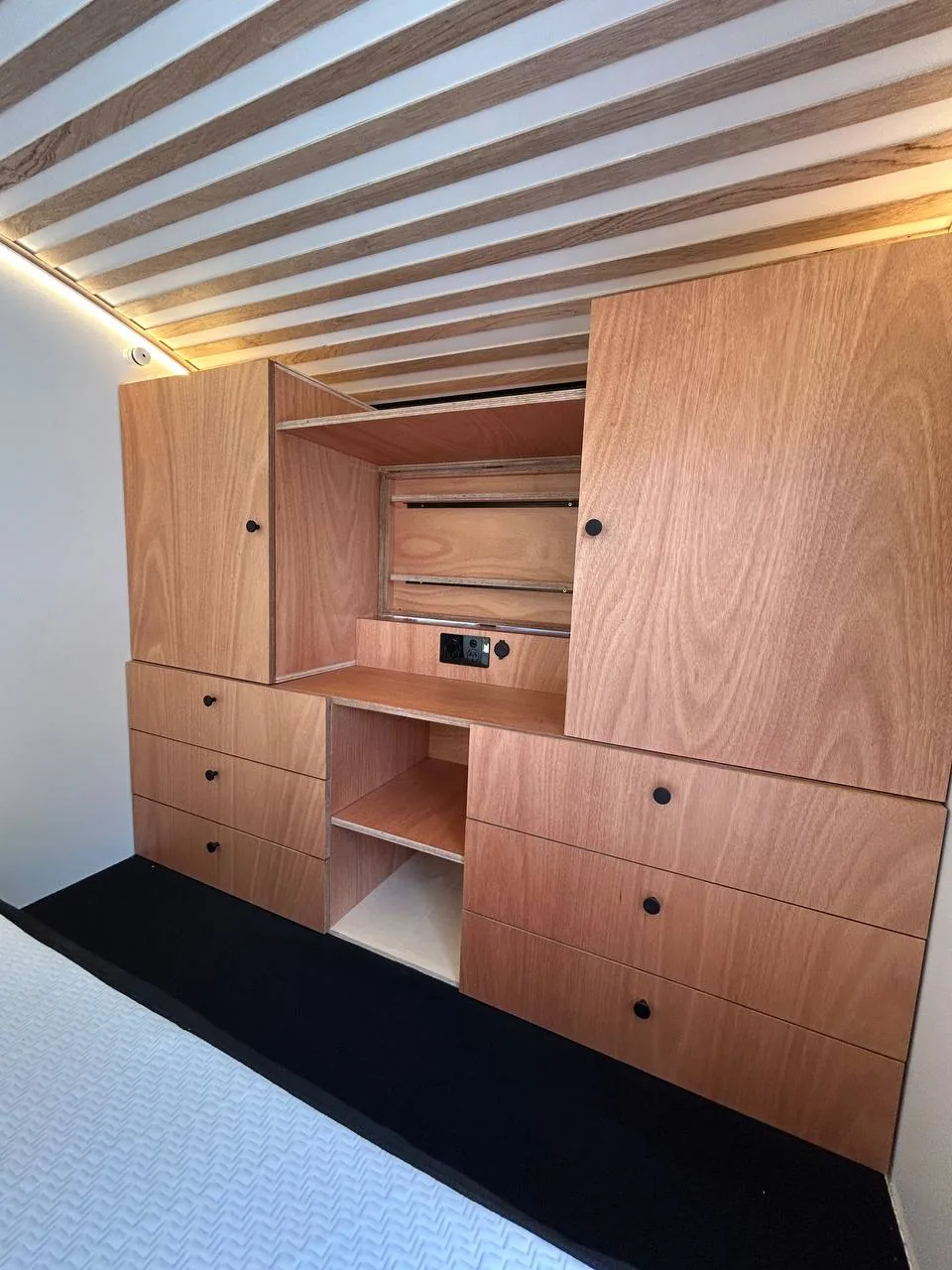
The material is only one part of the build. The way it is designed and assembled matters just as much.
At JAG, our cabinetry is:
- Designed around the camper rather than adapted from a generic cabinet system
- CNC machined locally in Brisbane
- Assembled by our own team
- Checked for fit, finish and operation during the build
- Integrated with the camper’s electrical, plumbing and storage systems
Local production gives us more control over tolerances, joinery, hardware placement and the final fit. It also means we can keep improving the design as we learn from building and using our campers.
Why the cheaper option is not always the better value
MDF cabinetry can reduce the initial manufacturing cost. That is one reason it is attractive for imported, pre-assembled camper interiors.
But the cheapest camper is not always the most affordable camper to own. A cabinetry system needs to cope with moisture, vibration, repeated use and years of opening, closing, loading and travelling.
Choosing marine grade plywood costs more upfront. CNC machining and assembling locally also costs more than fitting an imported cabinet package.
The benefit is that you are investing in a stronger, lighter and more durable camper from the beginning. Better materials can reduce the risk of swelling, damaged cabinetry and premature replacement, helping save money over the long term.
Durability can also matter when it is time to sell. A camper that has been well maintained and still has solid, functional cabinetry is more likely to appeal to future buyers and retain its value better than one showing signs of moisture damage or worn-out interior materials.
We do not choose marine grade plywood because it is the cheapest option. We choose it because we believe the higher upfront cost is justified by the quality, service life and long-term value of the finished camper.
See the difference in JAG teardrop camper cabinetry
The cabinetry in a JAG Camper is designed to be used, not just photographed when new. Open the doors, operate the drawers, look at the edges and inspect how the kitchen and storage areas are integrated into the camper.
The finish matters, but so does everything underneath it.
If you are comparing teardrop campers, ask what the cabinetry is made from, where it was made, how it is assembled and how the material is expected to perform in humid, vibrating and changing conditions.
To see the JAG Teardrop Camper and explore its cabinetry, view the JAG Teardrop Camper or contact our Brisbane team to arrange a factory tour.
Built here. Built properly. Built to last.
Explore More, Tow Less.