
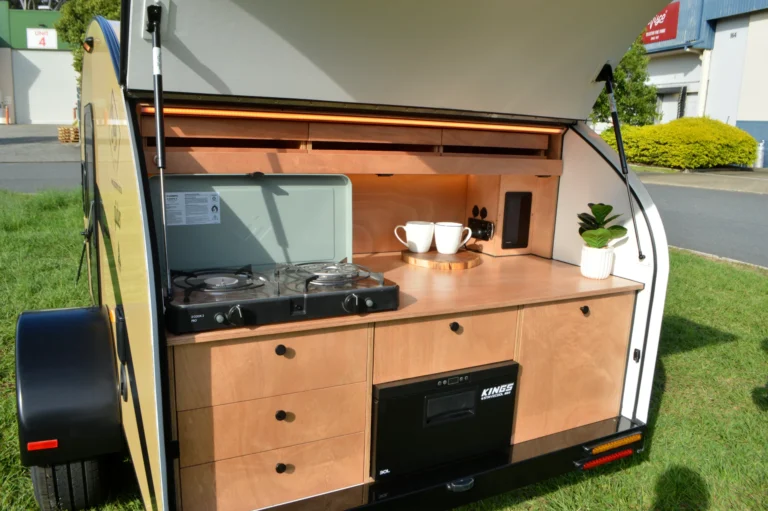
Quick answer: a lightweight caravan under 1000kg can be a smart choice in Australia, but only if you check the loaded weight, payload, tow ball weight and your vehicle’s limits. The brochure tare weight is not enough.
Under-1000kg campers appeal to buyers with smaller SUVs, wagons, hybrids, EVs and people who simply do not want a big towing setup. They can be easier to store, easier to reverse, less stressful on narrow sites and more realistic for quick trips. But “under 1000kg” can also hide a trap: some campers are under 1000kg empty, then creep close to the limit after water, battery upgrades, awnings, fridge, bedding, tools, food and personal gear.
After reading this, you should be able to compare lightweight campers properly and ask the seller for the weight numbers that actually affect towing.
The four weight numbers that matter
| Weight term | What it means | Why buyers should care |
|---|---|---|
| Tare | The camper’s empty weight as specified by the manufacturer. | Good for comparison, but it is not your real touring weight. |
| ATM | Aggregate Trailer Mass: maximum allowed loaded trailer weight when unhitched. | Your loaded camper must not exceed this. |
| Payload | The difference between tare and ATM. | This is your allowance for water, food, options and gear. |
| Tow ball weight | The downward load the trailer places on the tow vehicle. | Counts against the vehicle’s payload and ball limit. |
If a seller says a camper is under 1000kg, ask which number they mean. Under 1000kg tare is different from under 1000kg ATM, and both are different from the actual loaded weight you tow away on a trip.
Worked example: how a light camper gets heavy
Imagine a camper with an 860kg tare and a 1,200kg ATM. On paper, that gives 340kg of payload. That sounds generous until you start packing:
| Item | Approximate packed weight |
|---|---|
| Water | 80kg if carrying 80 litres |
| Food and pantry | 20-35kg |
| Bedding and clothes | 20-40kg |
| Camp chairs, table and shade gear | 20-45kg |
| Tools, hoses, leads and recovery basics | 15-35kg |
| Battery, solar or awning upgrades | Varies, often significant |
That camper may still be a good lightweight option, but the point is clear: payload disappears quickly. A buyer who never checks payload can accidentally turn a sensible lightweight camper into an overloaded one.
What types of campers are usually under 1000kg?
| Camper type | Typical under-1000kg suitability | Main trade-off |
|---|---|---|
| Teardrop camper | Very good | Compact indoor space, usually outdoor kitchen. |
| Ultra-light camper trailer | Very good if genuinely light | Setup style varies a lot between brands. |
| Small pop-top caravan | Possible but must be checked carefully | Can gain weight quickly with options. |
| Full-height micro caravan | Possible but less common | Height and drag may affect towing feel and fuel/range. |
| Off-road caravan | Usually difficult under 1000kg | Heavy chassis, suspension, tyres and protection add weight. |
Why under 1000kg can be a sweet spot
For many Australian buyers, the appeal is not just legality. It is day-to-day usability. Lighter campers are usually easier to move around a driveway, easier to store, easier to tow through small towns, and less intimidating if you are new to towing. They can also open up camping to buyers who do not want to own a ute or large 4WD.
The other advantage is trip frequency. A camper that is easy to hook up and tow is more likely to be used for regular weekends, not just one big annual trip. That matters more than people admit when they are standing in a showroom imagining a lap of Australia.
The checks to do before buying
- Check your vehicle braked towing capacity. Use the owner’s manual or manufacturer data.
- Check towbar rating. The towbar can have its own lower limit.
- Check tow ball download limit. A light camper can still have too much ball weight for some vehicles.
- Check payload in the camper. Ask what is included in tare and what options change the weight.
- Check vehicle payload. Passengers, luggage, accessories and ball weight all count.
- Ask for real measured weights. A weighbridge ticket is better than a vague brochure claim.
- Plan your normal packed load. Include water, food, bedding, tools, cords, hoses and camp furniture.
Common mistakes with lightweight caravans
- Shopping by tare only. Tare does not include your real camping load.
- Assuming all “lightweight” claims are equal. Some are light because they are compact and clever; others are light because they leave out things you may add later.
- Forgetting water weight. One litre of water is roughly one kilogram.
- Ignoring roof loads. Bikes, kayaks, solar and rooftop accessories can change weight, handling and drag.
- Over-optioning the camper. Batteries, awnings, hot water, storage boxes and spare wheels are useful, but they still count.
Where JAG fits
JAG focuses on lightweight teardrop-style campers rather than large conventional caravans. The JAG Glider is the lightest direction in the range, while the JAG Teardrop Camper is still compact compared with many full-sized caravans. Both suit buyers who care about towability, storage at home and regular weekend use.
That said, the same buying rules apply. Check the current specification, options, loaded weight, ball weight and your own vehicle limits before making a decision.
Buyer checklist
- What is the tare weight?
- What is the ATM?
- How much payload remains after common options?
- What is the measured tow ball weight?
- What does my vehicle manual say about towing and ball download?
- Will I usually travel with full water tanks?
- Can I store the camper at home without complicated manoeuvring?
- Would I still choose this camper if I packed for a real trip today?
Useful sources
FAQ
Is a caravan under 1000kg easy to tow?
It is usually easier than towing a larger caravan, but “easy” still depends on the loaded weight, ball weight, vehicle, towbar, road conditions and driver experience.
Does under 1000kg mean I can tow it with any car?
No. You still need to check the vehicle’s braked towing capacity, ball weight limit and payload. Some small cars have very low or no towing ratings.
Should I buy under 1000kg tare or under 1000kg ATM?
Under 1000kg ATM is the stricter claim because it refers to the maximum loaded trailer weight. Under 1000kg tare may still exceed 1000kg once packed.

