
Quick answer: EV camper trailer range is mostly affected by trailer shape, weight, speed, wind, hills, tyres and how much battery buffer you keep between chargers. A low, light camper gives you a much better starting point than a tall, heavy caravan, but you still need to test your own combination.
Towing with an EV can be excellent when the trailer is matched properly. Instant torque makes take-off easy, regenerative braking can help in the right conditions, and many EVs feel calm at low speed. The challenge is highway energy use. A camper that looks small in a driveway can still cut range heavily if it is tall, blunt, overloaded or towed too fast.
After reading this, you should be able to plan a realistic first EV towing trip, understand what affects range, and choose a camper that will not turn every drive into charger anxiety.
Why EV towing range changes so much
There is no honest universal number for EV towing range loss. Two drivers with the same EV can get different results because they tow different trailers, drive at different speeds, carry different loads and travel in different weather. Instead of chasing a magic percentage, focus on the variables you can control.
| Factor | Effect on range | What to do |
|---|---|---|
| Trailer height and frontal area | High impact at highway speed | Choose lower-profile campers where possible. |
| Trailer weight | High impact on hills, acceleration and stop-start driving | Keep loaded weight low and avoid unnecessary gear. |
| Speed | Very high impact because aero drag rises quickly | Test consumption at 90, 100 and 110km/h. |
| Wind | Headwinds and crosswinds can hurt range and stability | Leave larger battery buffers in exposed conditions. |
| Tyres and pressure | Rolling resistance affects efficiency | Use correct pressures for car and trailer. |
| Route | Hills and long gaps between chargers increase risk | Plan stops conservatively until you know your setup. |
Shape can matter as much as weight
Weight is easy to understand because it is a number on a plate. Shape is easier to underestimate. At suburban speeds, weight and rolling resistance are obvious. At highway speed, pushing air becomes a major energy cost. That is why a low, compact camper can perform better than a taller van with a similar weight.
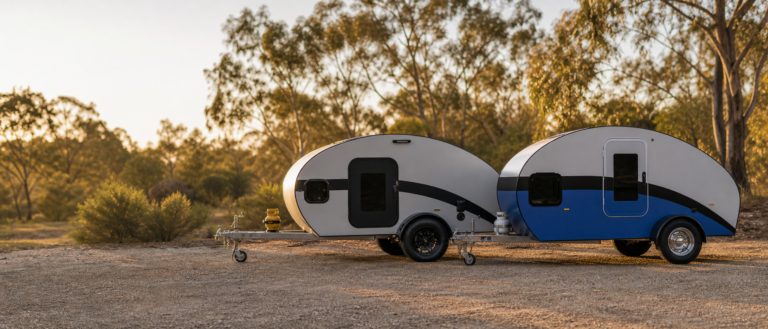
This is where teardrop-style campers make sense for EV owners. A lower profile, narrower body and cleaner shape generally give the EV less work to do than a full-height caravan. It does not make range loss disappear, but it improves the starting point.
Worked example: planning your first EV towing trip
Say your EV normally covers a comfortable 420km on the highway without towing. Do not plan your first towing trip assuming you still have 420km. Start with a conservative route where chargers are no more than 120-180km apart, especially if you are towing through hills, heat or headwinds.
On that first trip, record energy use at different speeds and states of charge. If the car uses noticeably less energy at 95km/h than 110km/h, that becomes useful trip knowledge. A slightly slower cruise can be the difference between one relaxed charging stop and a stressful one.
| First-trip habit | Why it helps |
|---|---|
| Keep a larger battery buffer than usual | Protects against wind, hills, charger queues and detours. |
| Use shorter charger gaps at first | Lets you learn real consumption without pressure. |
| Test different cruising speeds | Shows how much speed affects your range. |
| Weigh the camper loaded | Removes guesswork from trip planning. |
| Check charging bay layout | Some sites require unhitching or careful parking. |
Charging with a camper attached
Charging layout is one of the most practical EV towing issues. Many public chargers are designed like parking bays, not service-station drive-through lanes. With a compact camper, you may be able to park neatly or unhitch quickly. With a long caravan, you may block bays, need extra space, or spend time finding somewhere suitable.
Before a longer trip, check charging stops on satellite view where possible. Look for entry and exit space, nearby trailer parking, and whether the charger is likely to be busy. Build extra time into the route if you may need to unhitch.
How to choose a camper for better EV range
- Prioritise low profile over showroom size. Tall vans usually cost more energy at speed.
- Keep loaded weight honest. Water, food and gear are part of the towing range equation.
- Avoid roof clutter. Bikes, boxes and bulky accessories can add drag.
- Check ball weight and payload. Efficiency does not matter if the combination is overloaded.
- Think about charger manoeuvring. Compact trailers are easier to live with around awkward charging bays.
- Buy for normal trips first. Do not overbuy for one theoretical long expedition.
Common EV towing mistakes
- Using unloaded range for trip planning. Towing range needs its own testing.
- Ignoring speed. The difference between 95km/h and 110km/h can matter a lot.
- Assuming weight is everything. Aerodynamics can dominate at highway speed.
- Arriving at chargers with too little buffer. Chargers can be occupied, faulty or awkward to access.
- Choosing a camper that is legal but unpleasant. A combination can fit the tow rating and still be inefficient or annoying.
Where JAG fits
JAG’s lightweight teardrop campers fit the direction EV owners should usually investigate first: compact, relatively light, and easier to manage around charging stops than a large full-height caravan. The JAG Glider is the lightest JAG option, while the JAG Teardrop Camper gives more teardrop comfort while keeping the trailer far more compact than a conventional caravan.
That does not mean every EV and every JAG setup is automatically a perfect match. Bring your EV’s towing capacity, ball weight limit, payload and charging needs into the conversation. The right camper is the one that works with your real vehicle and your real trips.
EV towing range checklist
- Confirm the EV’s braked towing capacity and ball weight limit.
- Weigh the camper loaded for a normal trip.
- Plan the first route with shorter charger gaps.
- Leave more battery buffer than you would without towing.
- Test consumption at different highway speeds.
- Check charger layout before arriving with a trailer.
- Record what you learn and update future trip plans.
Useful sources
FAQ
How much range does an EV lose towing a camper?
It varies too much for a single honest figure. Trailer shape, loaded weight, speed, wind, hills and tyres all affect the result. Test your own combination before planning long charger gaps.
Is a teardrop camper better for EV range?
Often, yes. A low-profile teardrop usually has less frontal area and lower weight than a full-height caravan, which helps EV towing efficiency.
Should I tow slower with an EV?
Often it helps. Testing your own vehicle at different speeds is the best way to see the range difference. Many EV owners find a modest speed reduction makes towing stops easier to plan.

